
Update 2026-2-6
To start 2026 off right, we have some big news on Liberator II Maid of Athens -
Last year we ordered new stringers for which to restore the nose section. As of yesterday, they are now here.

Unlike the Boeing B-17, the Consolidated B-24’s stringer material is no longer regularly available. They were a unique Z shape, which required having replacement stringers custom made. We now have 600 ft of Liberator stringers, thanks to New Source Corp of Orlando, Florida. With these in hand, we can now get seriously deep into restoring her airframe.
Another new arrival comes from Mike Berry in the Great White North. In response to our update on the Liberator’s spot heaters, Mike hooked us up with the fourth heater (out of six needed) for Maid of Athens. This heater came with its original mounting brackets, complete with Consolidated part numbers. Upon closer inspection, these brackets indicate this unit was originally installed on a PBY flying boat. The unique green color suggests this particular PBY was not a Catalina but a Canso. Thanks Mike!
Lastly, we now have the carbon tet extinguisher for Maid of Athens.
To explain –
One of the bigger issues we face with this aircraft is the fact that she was built early in the war. This means that much of her equipment was different from what was later standardized. Worse yet, this also means that references on this equipment are hard to come by.
Early Liberators carried a pair of Type A-14 CO2 extinguishers and a single carbon tet in a flap by the nose wheel. The blueprints call for the latter to be an Army “Type A-2.” Wartime A-2s are generally associated with Fyr Fyter of Ohio, but the bracket for this unit is definitely not a Fyr Fyter. Not only does the drawing not match Fyr-Fyter type brackets, but the remains of the original bracket are still on Maid of Athens.
Looking up drawings of early B-17s, the fact that early A-2s were not Fyr-Fyters is further confirmed, as the shape of the unit is again not that of a Fyr Fyter. Eventually, we found the answer in a 1942 manual for initial run of B-24Ds: prior to Fyr Fyter, the A-2 contract was held by Pyrene.
Now, this is a bit of double-edged sword, as Pyrenes are easily the most common carbon tet on the collector’s market today. So, which Pyrene variant is the correct one? Well, as far as we can tell, only one Pyrene was produced specifically for aircraft. Our friend Gary Hall, of Woodbury, Minnesota, was kind enough to pick up an example of one of these special units over the Christmas break. Thanks Gary!
So now, when it comes to extinguishers, we have to keep an eye out for the A-14s. As far as we can tell, they seem to have used the same cylinder as the later A-17 and 4TB, just without the wire wrapping. The big difference is the hose assembly, which appears to be the same type used on large ground units. Looking around, we can find occasional examples of similar units, but all with flat bottoms rather than rounded ones, like on an aircraft extinguisher. Documentation on these units appear to no longer exist, though I strongly suspect that they were originally made by Kidde-Lux, based on the unique handle/thumb-switch design, assuming we are interpreting the installation drawings correctly. If anyone can help with these two units, please let us know!
Likewise, additional needs for the Liberator II's restoration involve Bendix radio and intercom equipment, early/prewar multiengine instruments, and .30/.303 cal armament equipment. If you can help with any of these needs, feel free to reach out!
We have some more BIG news for Project Warbird coming up, but this should be enough to get the year started right. Hope everyone enjoys!

Factory photo of a Liberator being converted into a C-87 Liberator Express.
Note Consolidated's practice: skins dipped in yellow chromate, with bare metal ribs and stringers. This practice was changed when the Army halted the requirement for camoflaged aircraft in 1944.
Photo taken October 1942.

The stringers are loaded up for their trip home to South Carolina.
Photo taken 3 February 2026.

An original stringer, with crash damage and bulletholes, is removed and replaced.
Photo taken 5 February 2026.
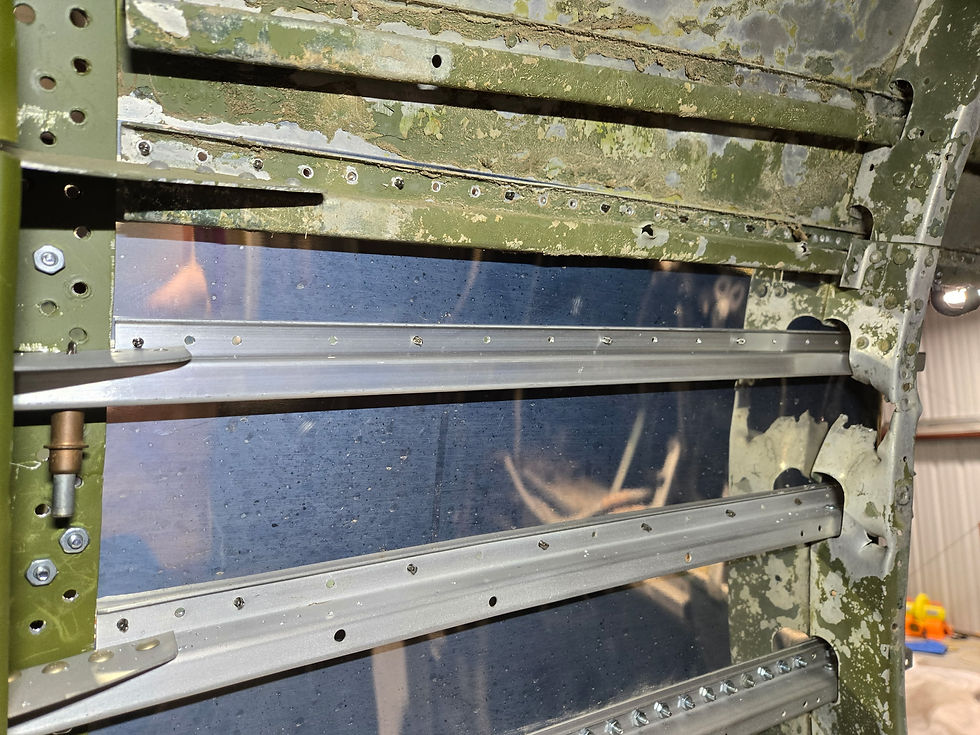
Replacement stringers are test fitted into the nose. How could we resist?
Much of the paint here was added when Maid of Athens had her nose converted into a cargo compartment after the war.
Photo taken 5 February 2026.

A Liberator II identical to Maid of Athens is loaded for operations out of Egypt with 159 Squadron.
The flap which holds the carbon tet extinguisher is visible above the nose wheel.

The newly arrived Stewart Warner 789 heater from Mike Berry.
Note the RAF interior green.
Photo taken 20 January 2026.

Manual image of the bombardier's position aboard a Liberator II. The interior to Maid of Athens will be identical to what you see here.
The Stewart Warner spot heater is visible on the right. A second heater was located at the rear of this compartment.

A comparison between the newly-arrived Pyrene carbon tet extinguisher and a restored Fyr-Fyter Type A-2 from Boeing B-17F Lucky Thirteen.
Photo taken 6 February 2026.

Blueprint from a Boeing B-17D showing one its carbon tet extinguishers.
You can see where it is described as a Type A-2, with the shape clearly not being a Fyr Fyter model.

Manual excerpt from the initial run of Consolidated B-24Ds which notes Pyrene by name.
Evidently, this was published before Fyr Fyter got the contract for the Type A-2.

The Liberator's blueprints for the carbon tet do not show the extinguisher itself - only the bracket.
But note how the base of the bracket is rounded - this bracket is not made for the flat-bottomed Fyr-Fyter.

The remains of the carbon tet extinguisher from Maid of Athens.
Photo taken 19 May 2025.

One of two photos we have found that show a Type A-14 CO2 extinguisher - this photo is from the experimental Bell YFM-1 Airacuda.
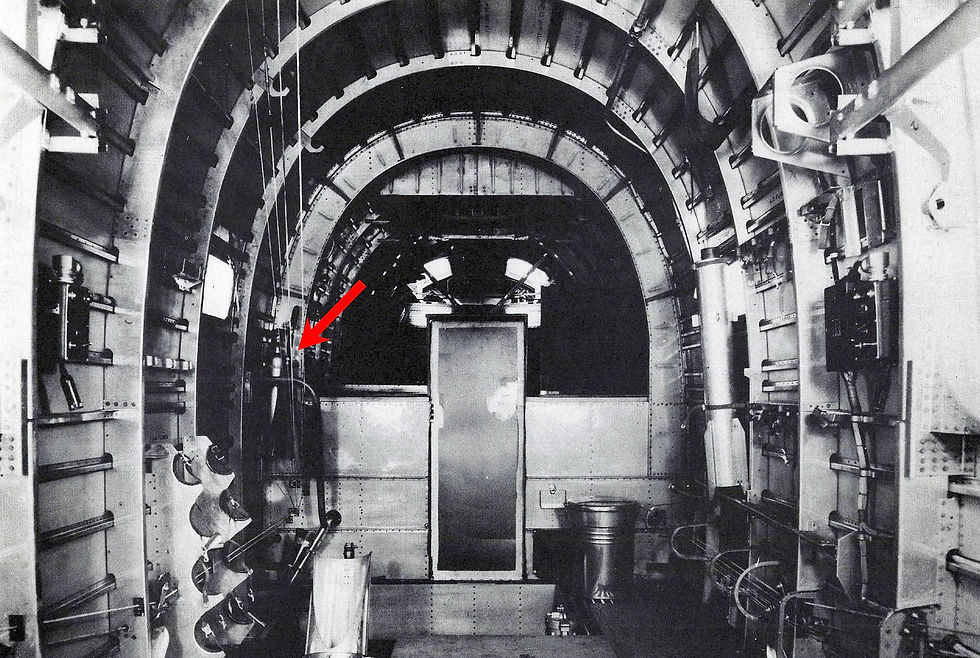
One of two photos we have found that show a Type A-14 CO2 extinguisher - this photo is of the aft fuselage of a Liberator II (identical to Maid of Athens.)

Tracing of the A-14 taken from the Liberator II's blueprints.
Maybe someone out there has one, has seen one, or at the very least, has components to help us make a pair?


